
DE, KE and E steam boilers: differences and modern alternatives
DE, KE and E series steam boilers are well known to industrial plants across the former Soviet Union. Many are still running today, but when the boiler house comes up for modernisation, the question arises: does the replacement have to be the same series, or is a modern alternative worth considering?
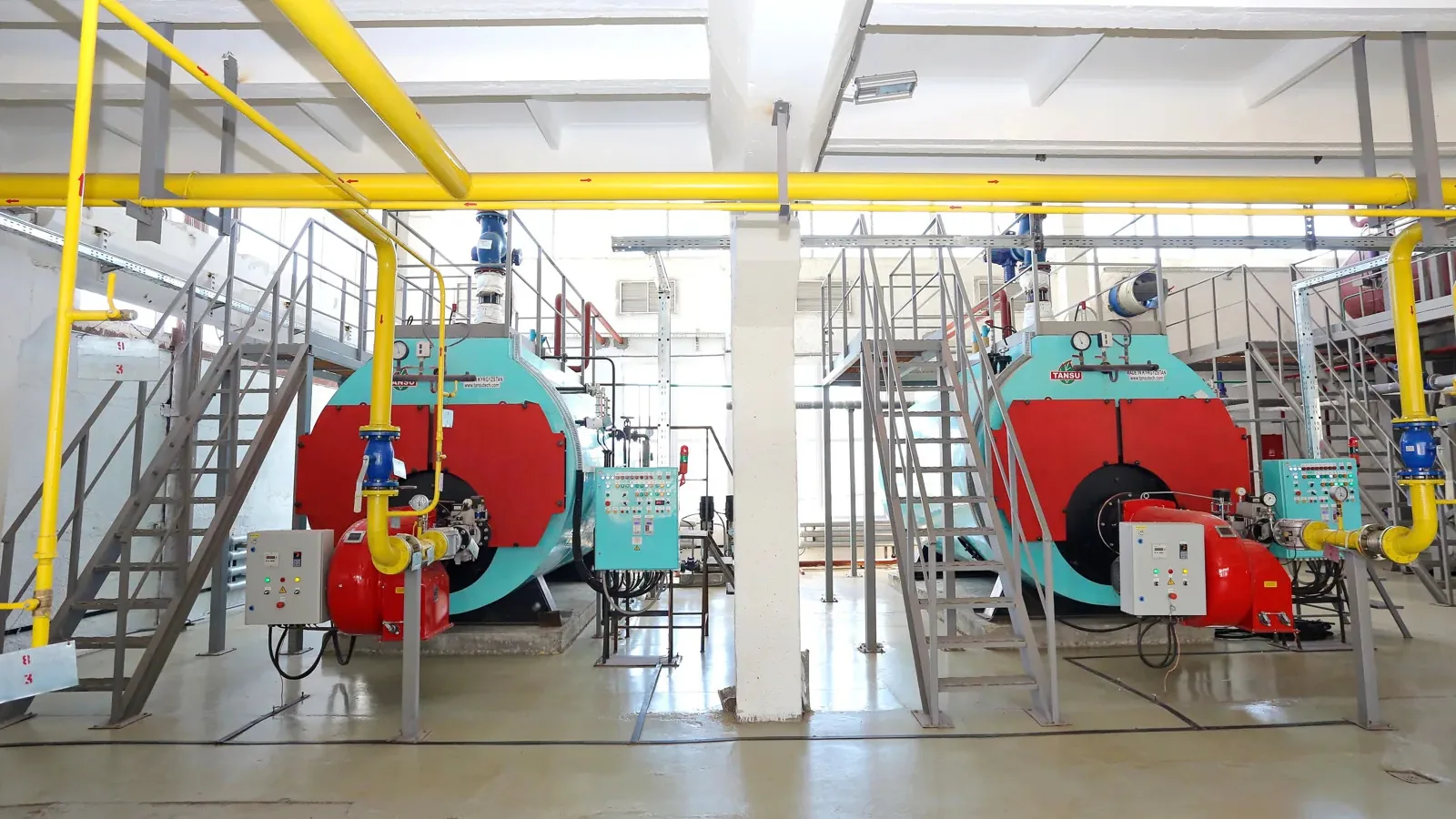
The answer depends not on the model name but on what the plant requires: steam output, pressure, fuel, operating schedule and operating conditions.
How do DE, KE and E boilers differ?
| Series | Design | Main fuel | Application |
|---|---|---|---|
| DE | Water-tube, twin-drum | Gas, liquid fuel | Process steam, heat supply |
| KE | Water-tube | Solid fuel | Industrial and municipal sites |
| E | Water-tube | Depends on the configuration | Process steam generation |
| TANSU | Fire-tube, three-pass | Gas, diesel, heavy fuel oil; a separate line for coal | Industrial production |
DE, KE and E are traditional water-tube designs. TANSU uses a different design: fire-tube.
So TANSU cannot be called a direct copy of a DE or KE. It is a more modern technology, worth considering when boiler equipment is being replaced or upgraded.
Why a DE replacement does not have to be another DE
A plant does not buy a boiler for the letters on its nameplate. Its task is to get the required amount of process steam at the specified parameters.
So a modernisation project needs to compare:
- steam output;
- working pressure;
- fuel type;
- fuel consumption;
- efficiency;
- load profile;
- water-treatment requirements;
- flue gas system;
- automation;
- service support and maintenance costs.
Water-tube or fire-tube?
In a water-tube boiler, the water is inside the tubes and the hot combustion products pass around them. Such boilers are sensitive to swings in feedwater quality, and a repair involving tube replacement can be long and technically demanding.
A fire-tube boiler is the other way round: combustion products pass inside the fire tubes and the water surrounds them. Such boilers tolerate swings in feedwater quality better than water-tube designs, and tube repair and replacement are usually faster and simpler.
Each design has its own trade-offs.
The TANSU fire-tube design provides a three-pass flue gas path, a large water volume and natural circulation.
For gas and liquid-fuel models the declared efficiency is up to 92%, and 95% and above with an economiser.
See the range on the TANSU gas and liquid-fuel steam boilers page.
TANSU fire-tube steam boilers: full-cycle manufacturing
TANSU is a full-cycle manufacturer of industrial boiler equipment.
Boilers ship with the required scope of supply. Depending on the project, this can include automation, burner equipment, blowdown systems, an economiser, a deaerator, a condensate tank and other components.
Gas and liquid fuel
- 300–25,000 kg/h
- up to 25 bar
- gas · diesel · heavy fuel oil
For plants running on coal, TANSU offers a separate line of coal-fired steam boilers.
Solid fuel
- 300–2,000 kg/h
- up to 25 bar
- hard and brown coal
Which plants do TANSU steam boilers suit?
Steam is a critical resource for many industries.
Food industry
- dairy plants;
- meat-processing plants;
- poultry farms;
- bakeries;
- confectionery plants;
- breweries;
- beverage producers;
- canneries.
What matters most here is stable steam supply, economy and minimal downtime.
Paper industry
Producing paper, board and corrugated products requires stable steam generation and uninterrupted equipment operation.
Building materials
Precast concrete, aerated concrete, brick, concrete and other production lines place high demands on energy efficiency and equipment reliability.
And if you need high temperature rather than steam?
A thermal oil system lets you reach a high heat-transfer fluid temperature without resorting to high-pressure steam.
For oil, gas and petrochemical plants, TANSU manufactures thermal oil boilers.
- Capacity: 500–3,000 kW
- Heat-transfer fluid temperature: up to 300 °C
Can a DE, KE or E be replaced with a TANSU?
Yes, in most projects.
But that is decided by the technical parameters of the specific site.
A TANSU is not a direct design analogue of a DE, KE or E. It is modern fire-tube equipment that can be considered an alternative when a boiler house is modernised.
To determine the right model, you need to know:
output → pressure → fuel → operating schedule → plant specifics.
Which is why, instead of searching only for a “DE boiler equivalent”, it is worth weighing different technologies.
We will select a boiler for your process
If your plant runs a DE, KE or E and the equipment is due for replacement, the search does not have to stop at the same series.
Compare different technologies and choose on operating cost, reliability, efficiency and your production requirements.
TANSU manufactures steam and thermal oil boilers for industry.
Send us the parameters of your current boiler and TANSU engineers will help select equipment for your site.